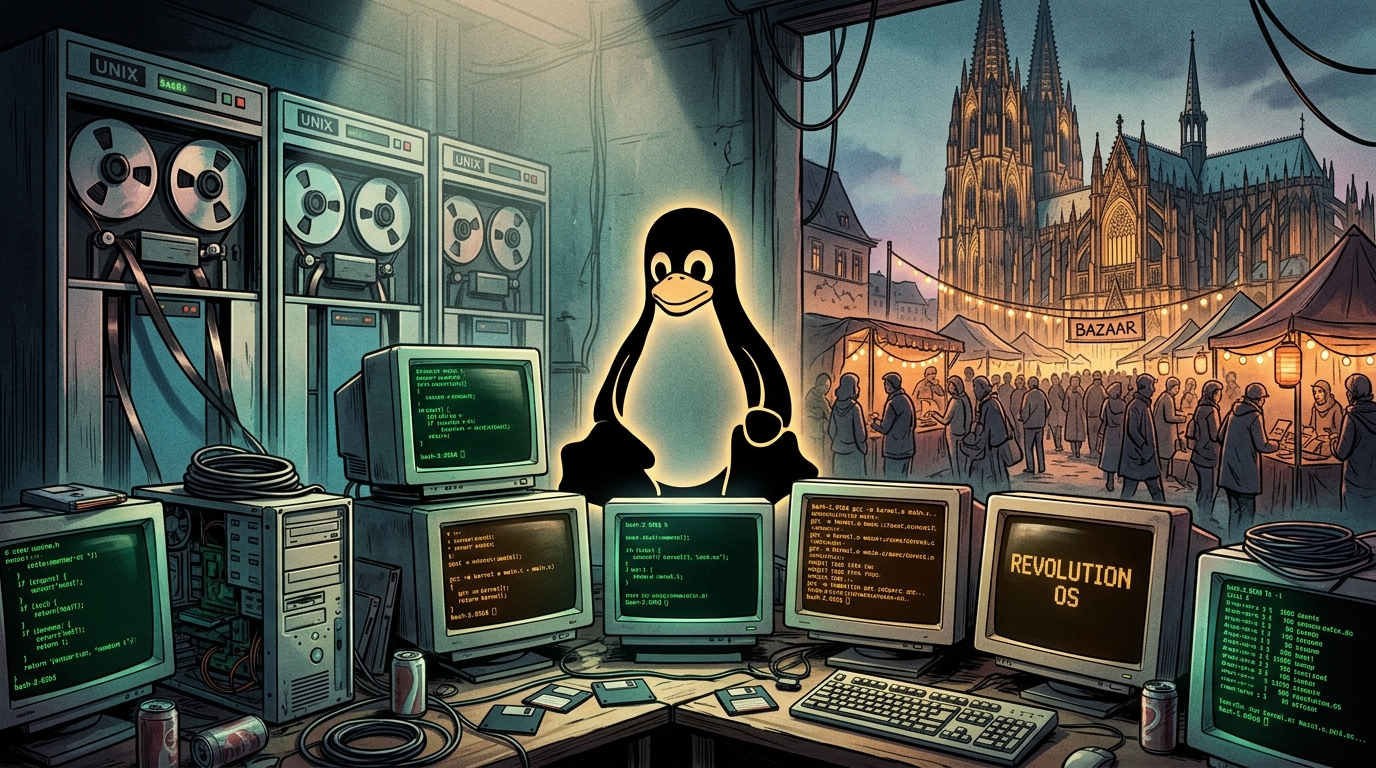
In 2001, an independent filmmaker named J.T.S. Moore released a documentary titled Revolution OS. Shot on vivid 35mm film across the frantic height of the dot-com bubble between 1999 and 2001, the film chronicled what appeared at the time to be an impossible, quixotic insurgency: a loose, decentralized confederation of bearded hackers, cyber-libertarian philosophers, academic dropouts, and barefoot programmers waging an asymmetric war against the most entrenched corporate monopoly in human history—Microsoft.
Viewed a quarter-century later, Revolution OS is not merely an entertaining artifact of early internet nostalgia. It is the primary visual and intellectual chronicle of the most consequential economic and technical paradigm shift in the history of computing.
It captures the precise historical pivot point where software evolved from a closely guarded corporate secret into a shared, planetary utility. It preserves on celluloid the foundational arguments that still govern our digital lives: the moral crusade of Richard Stallman, the engineering pragmatism of Linus Torvalds, the market dialectics of Eric S. Raymond, the civic idealism of Bruce Perens, and the predatory counter-offensives orchestrated from Redmond under Bill Gates and Steve Ballmer.
This review and historical companion provides an exhaustive technical and cultural dissection of Revolution OS. We will examine the documentary as cinema, trace its complete 30-year chronological timeline from the genesis of Unix to the dot-com gold rush, analyze the deep architectural and legal mechanics of the movement (monolithic kernels vs. microkernels, copyleft vs. permissive licensing), and evaluate where the revolution stands today in the era of hyperscale clouds and proprietary AI.
+---------------------------------------------------------------------------------------------------+
|                            THE 30-YEAR ROAD TO THE OPEN SOURCE REVOLUTION                         |
|                                                                                                   |
|  1969: Unix Genesis               1983-1985: GNU & FSF             1991: Linux 0.01               |
|  Thompson & Ritchie (Bell Labs)   Stallman's Xerox Jam             Linus Torvalds fills kernel void|
|  The Hacker Golden Age            The Four Freedoms & GPL          Tanenbaum-Torvalds Debate      |
|         |                                 |                                 |                     |
|         v                                 v                                 v                     |
|  1976: Gates' Open Letter         1987-1990: Userland Done         1993: Debian Founded           |
|  The enclosure of source code     GCC, Bash, Coreutils             Ian Murdock & Bruce Perens     |
|  Software as intellectual property The Hurd microkernel stall      DFSG & package management      |
|         |                                 |                                 |                     |
|         +---------------------------------+---------------------------------+                     |
|                                           |                                                       |
|                                           v                                                       |
|  1997: Cathedral & The Bazaar     1998: The Open Source Schism     1999: Dot-Com Wall Street Mania|
|  Eric S. Raymond's essay          Netscape liberates Navigator     Red Hat & VA Linux IPOs        |
|  "Release early, release often"   Palo Alto summit / OSI founded   Microsoft Halloween Documents  |
+---------------------------------------------------------------------------------------------------+
1. The Cinematic Canvas: Deconstructing J.T.S. Moore’s Direction
Before diving into compilers and licenses, Revolution OS must be evaluated as a work of documentary cinema. Directed, written, and produced by J.T.S. Moore, the film stands apart from the glossy, hyper-edited corporate retrospectives produced today.
The 35mm Aesthetic and Synth-Driven Cadence
Moore made the inspired decision to shoot his principal interviews on 35mm motion picture film rather than early digital video. The result is a warm, textured visual palette: deep blacks, naturalistic lighting, and fine film grain that treats computer scientists not like interchangeable tech talking heads, but like historical figures in an unfolding intellectual drama.
Complementing the cinematography is Moore’s own original electronic soundtrack. Driven by minimalist analog synthesizers, sequenced arpeggios, and rhythmic breakbeats, the score gives the mundane realities of open-source development—compiling C code in terminal emulators, debugging race conditions, reading USENET newsgroups, and debating copyright clauses—the suspense and momentum of a political heist thriller.
+---------------------------------------------------------------------------------------------------+
|                                 THE DRAMATIS PERSONAE OF REVOLUTION OS                            |
|                                                                                                   |
|   RICHARD STALLMAN (RMS)       LINUS TORVALDS               ERIC S. RAYMOND (ESR)                 |
|   "The Moral Prophet"          "The Pragmatic Engineer"     "The Market Ideologue"                |
|   - Founder, GNU & FSF         - Creator, Linux Kernel      - Author, The Cathedral & the Bazaar  |
|   - Moral absolutist           - Disinterested in politics  - Cyber-libertarian diplomat          |
|   - "Free as in speech"        - "I just want good code"    - Co-founder, OSI                     |
|                                                                                                   |
|   BRUCE PERENS                 BOB YOUNG & MARC EWING       LARRY AUGUSTIN                        |
|   "The Civic Architect"        "The Pragmatic Capitalists"  "The Wall Street Pioneer"             |
|   - Debian Project Leader      - Co-founders, Red Hat       - Founder, VA Linux Systems           |
|   - Author of DFSG             - "Give away the recipe,     - Historic 698% 1st-day IPO gain      |
|   - Co-founder, OSI              sell the restaurant"       - Hardware optimized for Linux        |
+---------------------------------------------------------------------------------------------------+
The Unfiltered Humanity of the Hacker Elite
Where modern tech documentaries are sanitized by corporate PR handlers, Revolution OS caught its subjects in their unvarnished, authentic elements:
- Linus Torvalds: Radiating low-key Scandinavian pragmatism, sitting in his San Jose home office in socks and sweatpants, smiling wryly as he demystifies his own mythology. In the film’s iconic opening sequence, he peers into the lens with self-deprecating deadpan: “Hello, this is Linus Torvalds, and I pronounce Linux as Linux.” He recalls his childhood in Finland typing machine code into his grandfather’s Commodore VIC-20, making it abundantly clear that he did not start an operating system to save the world; he started it because he was a broke 21-year-old student who couldn’t afford a commercial Unix workstation. He also recounts his awkward 1994 meeting with Stallman at DECUS in New Orleans, where Stallman sat in the front row vigorously challenging the naming conventions.
- Richard Stallman (RMS): Looming over the documentary like an Old Testament prophet wandering through Cambridge, Massachusetts. Stallman is fierce, uncompromising, and visibly wounded by the tech world’s willingness to trade human freedom for convenience. In one unforgettable scene, Stallman dons his alter-ego “St. IGNUcius” of the Church of Emacs, wearing an old hard-drive platter as a halo; in another, he plays a wooden recorder and sings the whimsical, melancholic Free Software Song. His refusal to back down on “GNU/Linux” is not mere vanity—it is a desperate defense of the moral philosophy behind the software.
- Eric S. Raymond (ESR): Portrayed as the swashbuckling cyber-libertarian theorist. In one of the documentary’s most memorable scenes, Raymond is filmed at a Pennsylvania gun range firing a semi-automatic handgun, explicitly drawing a parallel between the right to bear arms and the right of individuals to inspect and control their own software: both are bulwarks against centralized authoritarian control. Raymond plays the role of the master diplomat—the man who recognized that corporate suits would never accept Stallman’s anti-capitalist moralizing, and who systematically rebranded “Free Software” into “Open Source” to conquer Fortune 500 boardrooms.
- Bruce Perens: Providing the emotional and moral conscience of the film. Perens, who drafted the Debian Free Software Guidelines, speaks with quiet, unpretentious vulnerability about how the free software community gave a home to social misfits, eccentric loners, and disabled hackers who had been discarded by traditional corporate environments. He candidly shares his disillusionment when the Open Source Initiative became co-opted by corporate marketers looking for free labor.
- Michael Tiemann: The razor-sharp founder of Cygnus Solutions, filmed explaining the brilliant “Trojan Horse” economics of his company: large defense contractors and chip manufacturers were spending tens of millions of dollars attempting to write proprietary C compilers for new RISC architectures, while Cygnus could port GNU’s GCC in a few months for $250,000, outperforming vendor compilers and liberating enterprise clients.
- Frank Hecker: The Netscape systems engineer who drafted the pivotal internal whitepaper that convinced Netscape CEO Jim Barksdale and Marc Andreessen to gamble the company’s crown jewel—the Netscape Communicator source code—on an untamed open-source community.
- Bob Young: The folksy Canadian co-founder of Red Hat, explaining with razor-sharp business acumen how a company can generate hundreds of millions of dollars selling something that anyone can download for free: “We don’t sell software. We sell trust, support, and packaging. You can get water from the rain for free, but Perrier makes billions selling bottled water.”
- Larry Augustin: The calm, earnest founder of VA Linux Systems, filmed on the chaotic floor of the NASDAQ exchange on December 9, 1999, looking genuinely dazed as his stock ticker erupts in the largest first-day IPO pop in American financial history ($30 to $239.25 per share).
2. The Comprehensive Historical Timeline (1969 – Present)
To comprehend the narrative of Revolution OS, one must understand the three decades of architectural, legal, and political evolution that led to the documentary’s climax.
🧭 Interactive Companion Tool: Looking for an interactive, chronological roadmap? Explore our new Revolution OS Interactive Timeline Tool featuring real-time search, era jump navigation, historical quotes, and expandable milestones from 1969 to 2018.
Act I: The Eden of Unix and The Great Enclosure (1969–1983)
1969: The Genesis of Unix at Bell Labs
In 1969, following the collapse of the over-engineered, multi-institutional Multics (Multiplexed Information and Computing Service) project, Ken Thompson, Dennis Ritchie, Brian Kernighan, and Doug McIlroy at AT&T Bell Laboratories designed a lightweight, interactive, multi-user operating system: Unix.
Written initially in assembly for a discarded DEC PDP-7, and subsequently rewritten by Ritchie in his newly created C programming language in 1972–1973, Unix revolutionized systems architecture. By decoupling the operating system from proprietary hardware architectures through C, Unix became portable.
The system was governed by what would become known as the Unix Philosophy:
- Write programs that do one thing and do it well.
- Write programs to work together.
- Write programs to handle text streams, because that is a universal interface.
+---------------------------------------------------------------------------------------------------+
|                                      THE UNIX PIPELINE PHILOSOPHY                                 |
|                                                                                                   |
|   [ cat access.log ] ===(stdout/stdin)===> [ grep "404" ] ===(stdout/stdin)===> [ wc -l ]        |
|     (Source Stream)       Text Pipe         (Filter Logic)     Text Pipe       (Aggregator)       |
+---------------------------------------------------------------------------------------------------+
Because AT&T was operating under a 1956 federal consent decree as a regulated telecommunications monopoly, it was prohibited from selling commercial computer software. Consequently, AT&T distributed Unix source code to universities (notably the University of California, Berkeley) for the nominal cost of media and shipping. A vibrant, cross-institutional hacker culture flourished, with universities patching bugs, adding features (such as BSD’s TCP/IP stack), and freely mailing magnetic tapes to one another.
1976: Bill Gates and the Enclosure of the Digital Commons
As microcomputers (such as the Altair 8800) emerged in the mid-1970s, hobbyist communities like the Homebrew Computer Club in Menlo Park, California, treated software as a collective, shared resource. Programmers copied paper tapes containing Altair BASIC and passed them along to friends.
In February 1976, a 20-year-old Bill Gates, co-founder of Micro-Soft, penned his historic “Open Letter to Hobbyists”. Gates was incandescent with rage:
“As the majority of hobbyists must be aware, most of you steal your software. Hardware must be paid for, but software is something to share. Who cares if the people who worked on it get paid?… Who can afford to do professional work for nothing? What hobbyist can put 3-man years into programming, finding all bugs, documenting his product and distribute for free?”
Gates’ letter marked the ideological declaration of software enclosure. It drew a firm, unyielding boundary between hardware (capital assets) and software (proprietary intellectual property protected by copyright). Over the next decade, source code was locked away. Compilers no longer shipped with source files; customers received only opaque, compiled binary blobs.
1980: The Xerox 9700 Paper Jam and Stallman’s Epiphany
At the MIT Artificial Intelligence Laboratory, Richard Stallman was immersed in the pure hacker culture of the PDP-10 and the Incompatible Timesharing System (ITS). The lab received a brand-new Xerox 9700 laser printer—a massive, high-speed industrial machine.
Previously, with older printers, Stallman had modified the driver source code so that whenever the printer jammed, the machine would broadcast a message across the local network to everyone with an active print job. Users would clear the jam, and workflow remained uninterrupted.
The Xerox 9700, however, jammed constantly, leaving documents piled up and researchers frustrated. Stallman went to the researchers at Carnegie Mellon University who had the device driver source code and requested a copy so he could re-implement the jam alert. They refused, citing a newly signed Non-Disclosure Agreement (NDA) with Xerox.
To Stallman, this was not a business transaction; it was a moral betrayal:
“The refusal to share with your neighbor is an act of spiritual suicide… An NDA is an agreement to betray your fellow man.”
When the MIT AI Lab’s PDP-10 hardware was retired and replaced by proprietary commercial machines running closed systems, the old MIT hacker community fragmented. Stallman was left with a stark choice: surrender to the proprietary software regime, or dedicate his life to building a completely free operating system from scratch.
Act II: The Prophet in the Desert: GNU, FSF, and Copyleft (1983–1990)
September 27, 1983: The GNU Announcement
On September 27, 1983, Stallman posted a historic message to the USENET newsgroups net.unix-wizards and net.works:
From: [email protected] (Richard Stallman)
Subject: new UNIX implementation
Date: 27 Sep 83 18:35:46 GMT

Starting this Thanksgiving I am going to write a complete Unix-compatible
software system called GNU (for Gnu's Not Unix), and give it away free
to everyone who can use it...
GNU was chosen via a classic recursive acronym (GNU’s Not Unix). Stallman chose Unix compatibility not because he loved Unix design, but because Unix was the established standard among technical professionals; portability and familiar POSIX semantics would minimize friction for adoption.
+---------------------------------------------------------------------------------------------------+
|                                  THE FOUR ESSENTIAL SOFTWARE FREEDOMS                             |
|                                                                                                   |
|   FREEDOM 0                       FREEDOM 1                       FREEDOM 2                       |
|   The freedom to RUN the          The freedom to STUDY how the    The freedom to REDISTRIBUTE     |
|   program for any purpose.        program works and CHANGE it.    copies to help your neighbor.   |
|   (Universal execution)           (Source code access required)   (Unrestricted sharing)          |
|                                                                                                   |
|                                           FREEDOM 3                                               |
|                           The freedom to DISTRIBUTE MODIFIED versions so                          |
|                           the entire community benefits from your improvements.                   |
|                           (Collective evolution)                                                  |
+---------------------------------------------------------------------------------------------------+
In 1985, Stallman published the GNU Manifesto and founded the Free Software Foundation (FSF), a 501(c)(3) non-profit dedicated to funding the development of free software and defending user rights.
1989: The Legal Masterstroke—The GNU General Public License (GPL)
Stallman recognized that releasing software into the Public Domain or under permissive terms (like the early MIT License or BSD License) had a fatal structural flaw: a proprietary vendor could take the freely contributed code, make proprietary modifications, compile it into a binary, and distribute it under a closed license without sharing the source code back.
To prevent this asymmetric corporate extraction, Stallman, working alongside legal scholar Jerry Cohen, invented Copyleft:
   (C) Copyright Law  ===[ Inverted via Hack ]===>  (ɔ) Copyleft Law
   "All Rights Reserved"                            "All Rights Reversed"
   Locks source code away                           Guarantees source code stays free
In 1989, Stallman released version 1 of the GNU General Public License (GPL), followed by the landmark GPL version 2 (GPLv2) in 1991. The core mechanism of the GPL is its reciprocal (protective) clause:
$\text{If } \text{Software } B \text{ is derived from } A \text{ (where } A \in \text{GPL}), \implies B \text{ MUST be distributed under GPL}.$
The GPL was a legal judo throw. It used the coercive machinery of copyright law—the very framework proprietary companies used to restrict users—to guarantee that the software, and all downstream derivatives, remained permanently free.
The Technical Assembly and the Hurd Quagmire
Throughout the late 1980s, the FSF achieved astonishing engineering milestones. Piece by piece, they built the entire userland of a modern Unix-like operating system:
- GCC (GNU Compiler Collection / GNU C Compiler): Written largely by Stallman, it quickly surpassed commercial vendor compilers in optimization and platform support.
- GNU Emacs: The extensible, self-documenting text editor.
- GNU Bash (Bourne Again Shell): The ubiquitous command line interpreter.
- GNU Coreutils (
ls,cat,cp,mv,grep,awk,sed): High-performance reimplementations of traditional Unix utilities. - GDB (GNU Debugger) and glibc (GNU C Library).
By 1990, the GNU project possessed an entire operating system—except for the single most complex component: the kernel.
+---------------------------------------------------------------------------------------------------+
|                                 THE 1990 GNU SYSTEM COMPONENT GAP                                 |
|                                                                                                   |
|   +-------------------------------------------------------------------------------------------+   |
|   | APPLICATION LAYER: GNU Emacs, Ghostscript, Groff, Make, Autotools                         |   |
|   +-------------------------------------------------------------------------------------------+   |
|   | COMMAND SHELL & UTILITIES: Bash, Coreutils (ls, grep, awk, sed, tar, gzip)                |   |
|   +-------------------------------------------------------------------------------------------+   |
|   | SYSTEM LIBRARIES & TOOLCHAINS: glibc, GCC, GDB, Binutils, ld                              |   |
|   +-------------------------------------------------------------------------------------------+   |
|   | THE KERNEL (HARDWARE ABSTRACTION, PROCESS MANAGEMENT, MEMORY, VFS):                       |   |
|   |                        [ MISSING / GNU HURD STALLED ]                                    |   |
|   +-------------------------------------------------------------------------------------------+   |
|   | HARDWARE LAYER: x86 CPU, RAM, Disk Controllers, Network Interfaces                        |   |
|   +-------------------------------------------------------------------------------------------+   |
+---------------------------------------------------------------------------------------------------+
The FSF chose to build its kernel, GNU Hurd, on top of the Mach microkernel developed at Carnegie Mellon University. In theory, a microkernel was pure, elegant, and modular: the core kernel ran only the bare minimum (IPC, virtual memory, scheduling), while file systems, network stacks, and device drivers ran as isolated user-space servers communicating via message passing.
In practice, the Mach-based Hurd was an architectural nightmare. Debugging multi-server asynchronous message passing without advanced tooling led to crippling performance bottlenecks, complex deadlocks, and endless development delays. The Hurd was hopelessly stalled.
Act III: The Accidental Kernel and the Finnish Spark (1991–1993)
Linus Torvalds and the Intel 80386
In 1991, in Helsinki, Finland, a 21-year-old computer science student named Linus Torvalds purchased an IBM-compatible PC equipped with the new Intel 80386 microprocessor. The 386 was a revolutionary chip: it featured true 32-bit architecture, hardware memory management (MMU) with paged virtual memory, and hardware-enforced protection rings (Ring 0 for kernel space, Ring 3 for user space).
Torvalds was studying Minix, a small educational Unix-like system written by Professor Andrew Tanenbaum. However, Minix was hobbled: Tanenbaum designed it purely for pedagogical purposes, refused to add complex performance optimizations, and restricted its license to educational use. Furthermore, Minix was 16-bit and failed to exploit the 386’s hardware paging capabilities.
Torvalds began writing a terminal emulator to dial into the university’s Unix computer. To understand the hardware, he wrote task-switching routines, disk drivers, and a file system implementation. Before he realized it, he had written the core of a Unix-like kernel.
August 25, 1991: The comp.os.minix Announcement
On August 25, 1991, Torvalds posted his now-legendary message:
From: [email protected] (Linus Benedict Torvalds)
Newsgroups: comp.os.minix
Subject: What would you like to see most in minix?
Date: 25 Aug 91 20:57:08 GMT

Hello everybody out there using minix -

I'm doing a (free) operating system (just a hobby, won't be big and
professional like gnu) for 386(486) AT clones. This has been brewing
since april, and is starting to get ready. I'd like any feedback on
things people like/dislike in minix, as my OS resembles it somewhat
(same physical layout of the file-system (due to practical reasons)
among other things).

I've currently ported bash(1.08) and gcc(1.40), and things seem to work.
This implies that I'll get something practical within a few months...
Notice the historical irony preserved in this post: Torvalds specifically writes that his project is “just a hobby, won’t be big and professional like gnu”.
+---------------------------------------------------------------------------------------------------+
|                             THE TANENBAUM-TORVALDS DEBATE (JANUARY 1992)                          |
|                                                                                                   |
|   ANDREW TANENBAUM (Minix Creator)              LINUS TORVALDS (Linux Creator)                    |
|   - "Linux is obsolete from day one."           - "Microkernels are an unproven academic theory." |
|   - "Monolithic kernels are a giant step back   - "A monolithic kernel written today works."      |
|     into the 1970s."                            - "Linux beats Minix because it actually exploits |
|   - "Microkernel design is the only modern        the 386 hardware instead of hiding behind an    |
|     way to write an operating system."            academic abstraction."                          |
+---------------------------------------------------------------------------------------------------+
The Architecture of Pragmatism: Monolithic vs. Microkernel
Tanenbaum attacked Linux on architectural grounds. In a microkernel, if the file system crashes, only that user-space server restarts; the kernel survives. In a monolithic kernel like Linux, all core services—process scheduler, memory manager, virtual file system (VFS), network protocols, and device drivers—operate in a single unified address space in Ring 0.
+---------------------------------------------------------------------------------------------------+
|                                MONOLITHIC KERNEL VS. MICROKERNEL                                  |
|                                                                                                   |
|   LINUX (MONOLITHIC ARCHITECTURE)               GNU HURD / MACH (MICROKERNEL ARCHITECTURE)        |
|   +---------------------------------------+     +-----------------------------------------------+ |
|   | USER SPACE (Ring 3)                   |     | USER SPACE (Ring 3)                           | |
|   | - Bash, GCC, Nginx, User Applications |     | - Bash, Applications                          | |
|   +-------------------+-------------------+     | - VFS Server, TCP/IP Server, Driver Daemons   | |
|                       | System Calls (fast)     +-----------------------+-----------------------+ |
|                       v                                                 | IPC Message Passing     |
|   +---------------------------------------+                             v (high context-switch)   |
|   | KERNEL SPACE (Ring 0)                 |     +-----------------------------------------------+ |
|   | - VFS & File Systems (ext4, btrfs)    |     | KERNEL SPACE (Ring 0)                         | |
|   | - Network Stack (TCP/IP, Netfilter)   |     | - Minimal Core: IPC, Virtual Memory, Sched    | |
|   | - Process Scheduler & Memory Manager  |     +-----------------------------------------------+ |
|   | - Hardware Device Drivers             |                                                       |
|   +---------------------------------------+                                                       |
+---------------------------------------------------------------------------------------------------+
Torvalds’ counter-argument was pragmatic: while microkernels were theoretically cleaner, the relentless context-switching overhead and IPC message serialization imposed severe performance penalties on 1990s hardware. A monolithic kernel, properly written in C with clean internal interfaces, delivered maximum throughput and direct access to CPU hardware. Time proved Linus right in the server and workstation space: Linux was lightning-fast.
1992: The Marriage of GNU and Linux
Initially, Torvalds distributed Linux under a custom license that prohibited commercial redistribution. However, in early 1992, recognizing the contributions of global hackers sending patches via email, Linus made the most pivotal decision of his career: he adopted the GNU GPLv2 for Linux version 0.12.
The missing puzzle piece had arrived. The GNU Project had spent eight years building the compilers, utilities, libraries, and shells; Linus had built the working monolithic kernel. When combined, they formed a complete, fully functional, 100% free POSIX operating system.
The Great “What If”: The USL v. BSDi Lawsuit and the Vacuum Linux Filled
One of the most profound historical revelations highlighted in Revolution OS is that Linux was nearly rendered redundant before it ever left Finland.
In 1991–1992, computer scientists William and Lynne Jolitz released 386BSD, a direct port of the University of California Berkeley’s Networking Release 2 (Net/2) to the Intel 80386. Unlike Linux, which was an immature, embryonic kernel cobbled together by a college student, 386BSD was a complete, battle-tested, industrial-grade Unix operating system containing thirty years of Bell Labs and Berkeley heritage, including the legendary BSD TCP/IP networking stack.
Then lightning struck the BSD community. In 1992, AT&T’s subsidiary, Unix System Laboratories (USL), filed a federal lawsuit against Berkeley Software Design, Inc. (BSDI) and UC Berkeley, alleging copyright infringement, trademark violation, and theft of proprietary AT&T trade secrets. USL sought a federal injunction to halt all distribution of Net/2 and 386BSD.
+---------------------------------------------------------------------------------------------------+
|                                  THE 1992–1994 BSD LEGAL FREEZE                                   |
|                                                                                                   |
|   386BSD (Berkeley Net/2)                 LINUS TORVALDS' LINUX KERNEL                            |
|   - Complete, mature Unix OS              - Scrappy, incomplete academic project                  |
|   - Hit with AT&T / USL Lawsuit (1992)    - Clean-room implementation (0% AT&T code)              |
|   - Under federal legal cloud             - Legally safe under GNU GPLv2                          |
|   - Developers froze contributions        - Global hackers poured all effort into Linux           |
|                                                                                                   |
|   OUTCOME: By the time USL v. BSDi settled in 1994, Linux had captured irreversible momentum.     |
+---------------------------------------------------------------------------------------------------+
For two critical years (1992 to 1994), 386BSD sat under a cloud of existential legal dread. Corporate lawyers warned developers that writing code for BSD could make them targets of AT&T’s litigation armada.
Programmers who hungered for a free, 32-bit Unix on cheap PC hardware had only one safe sanctuary: Linux. Because Linus had written his kernel from scratch as a clean-room implementation with zero AT&T proprietary code, Linux was legally untouchable. The worldwide hacker diaspora abandoned the paralyzed BSD projects and channeled their collective labor into Linux.
Years later, Linus Torvalds candidly reflected on this historical contingency:
“If 386BSD had been available when I started, I probably would not have written Linux.”
By the time the USL lawsuit settled in 1994 (with UC Berkeley vindicated and only a trivial handful of disputed files rewritten for 4.4BSD-Lite), it was too late for BSD. The Linux kernel had already built a global developer flywheel that no competitor could match.
Act IV: The Distribution Era: Debian, Red Hat, and Commercial Viability (1993–1996)
In 1992, installing Linux required formatting raw 3.5-inch floppies (one for the boot disk, one for the root disk), manually compiling device drivers, and hand-crafting partition tables with fdisk. To become viable for non-kernel hackers, Linux required distributions—packaged bundles of the kernel, GNU userland, installer scripts, and pre-compiled software packages.
+---------------------------------------------------------------------------------------------------+
|                                  THE RISE OF LINUX DISTRIBUTIONS                                  |
|                                                                                                   |
|   COMMUNITY-DRIVEN / CIVIC MODEL                COMMERCIAL / ENTERPRISE MODEL                     |
|   +---------------------------------------+     +-----------------------------------------------+ |
|   | DEBIAN (Ian Murdock & Bruce Perens)   |     | RED HAT (Bob Young & Marc Ewing)              | |
|   | - Founded August 1993                 |     | - Founded 1993 / Incorporated 1995            | |
|   | - 100% Volunteer / Democratic         |     | - Commercial Enterprise Packaging             | |
|   | - Debian Social Contract & DFSG       |     | - Red Hat Package Manager (RPM)               | |
|   | - dpkg / APT package ecosystem        |     | - Enterprise Support Contracts                | |
|   | - Pure adherence to software freedom  |     | - The Red Hat Linux "Boxed Set" at retail     | |
|   +---------------------------------------+     +-----------------------------------------------+ |
+---------------------------------------------------------------------------------------------------+
1993: Debian and the Civic Ideal
In August 1993, Purdue University undergraduate Ian Murdock founded the Debian project (named after his girlfriend Debra and himself). Murdock envisioned a distribution built openly in the spirit of the Linux kernel itself—not as a commercial product, but as a meticulously maintained, non-profit community project.
Under the leadership of Bruce Perens (who succeeded Murdock as project leader), Debian codified the Debian Social Contract and the Debian Free Software Guidelines (DFSG). Perens established strict criteria for what qualified as free software, ensuring that Debian main repositories would remain strictly free from proprietary contamination. Debian also developed dpkg and later apt-get, solving the notorious “dependency hell” of manual source compilation.
1993–1995: Cygnus and Red Hat Prove the Business Model
Skeptics in the software industry argued that open source was an unsustainable hobby: if the software is free, how can anyone make money?
The first answer came from Michael Tiemann, who founded Cygnus Solutions in 1989. Tiemann’s motto was simple: “We support free software.” Cygnus ported GCC to new embedded microprocessors, added features for enterprise clients, and charged hefty engineering consulting and maintenance fees. By 1995, Cygnus was highly profitable, demonstrating that software development could be sustained as a service rather than an artificial monopoly on binary copies.
In 1994, Bob Young merged his catalog business with Marc Ewing’s Linux distribution to create Red Hat Software. Ewing had created a clean distribution named after the red Cornell lacrosse hat given to him by his grandfather.
Bob Young identified the core economic insight of the open-source industry:
- When a customer buys proprietary software from Microsoft, they are locked in. If Microsoft discontinues the product or raises prices, the customer is helpless.
- When a customer buys Red Hat Linux, they are paying for risk mitigation, testing, certification, and accountability. Red Hat compiled the code, verified hardware compatibility, printed manuals, and provided telephone technical support. If Red Hat failed to provide good service, the customer could fire them and hire another vendor without throwing away their operating system.
Act V: The Pragmatic Schism: “Open Source” vs. “Free Software” (1997–1998)
By 1997, Linux was quietly taking over the infrastructure of the internet. The Apache HTTP Server (created in 1995 by Brian Behlendorf and a team of webmasters) was demolishing proprietary web servers from Netscape and Microsoft on top of Linux and BSD.
However, corporate America remained terrified of Richard Stallman. To Fortune 500 Chief Information Officers (CIOs) and Silicon Valley venture capitalists, Stallman’s rhetoric sounded like communist philosophy: he talked about “moral duty,” “solidarity,” and condemned proprietary software as evil.
+---------------------------------------------------------------------------------------------------+
|                                  THE GREAT PHILOSOPHICAL SCHISM                                   |
|                                                                                                   |
|   FREE SOFTWARE (Richard Stallman / FSF)        OPEN SOURCE (Eric S. Raymond / Bruce Perens / OSI)|
|                                                                                                   |
|   * Moral & Ethical Imperative                  * Pragmatic Engineering Methodology               |
|   * Software freedom is a fundamental human     * Peer review yields higher reliability, faster   |
|     right of the user.                            security patching, and lower TCO.               |
|   * Proprietary software is an antisocial       * Commercial friendly; designed to appeal to      |
|     injustice.                                    CIOs, Wall Street, and venture capital.         |
|   * Emphasizes "Free as in Speech, not Beer."   * Emphasizes developer collaboration and markets. |
|   * Slogan: "Freedom above all."                * Slogan: "Given enough eyeballs, all bugs are    |
|                                                   shallow."                                       |
+---------------------------------------------------------------------------------------------------+
1997: The Cathedral and the Bazaar
In May 1997, Eric S. Raymond (ESR) presented an academic paper at the Linux Kongress in Würzburg, Germany, titled The Cathedral and the Bazaar.
Raymond analyzed two fundamentally different software engineering paradigms:
- The Cathedral Model: Exemplified by traditional commercial software (and even the GNU project’s early days). Software is crafted by an elite priesthood of centralized developers, working in isolation behind closed doors, releasing software only after years of monolithic planning.
- The Bazaar Model: Exemplified by Linus Torvalds and the Linux kernel. A chaotic, noisy, distributed marketplace of ideas where code is released early and often, peer-reviewed in public, and tested continuously by thousands of developers across the globe.
Raymond formulated Linus’s Law:
“Given enough eyeballs, all bugs are shallow.”
In a proprietary model, finding a subtle concurrency bug depends on whether the vendor’s internal QA team happens to stumble across it. In the bazaar model, because thousands of developers with different hardware architectures, compiler flags, and workloads run the code, someone will immediately spot the anomaly, diagnose it, and send a diff back to the maintainer.
January 1998: The Netscape Defection
In late 1997, Netscape Communications was losing the browser wars. Microsoft was ruthlessly leveraging its Windows desktop monopoly to crush Netscape Navigator by illegally bundling Internet Explorer directly into Windows 95 and Windows 98.
Netscape engineer Frank Hecker read Raymond’s The Cathedral and the Bazaar and wrote an internal memo arguing that Netscape’s only hope of survival was to adopt the bazaar model: give away the source code to Navigator.
On January 22, 1998, Netscape CEO Jim Barksdale shocked the technology world by announcing that Netscape would make the source code of its flagship browser freely available. (This codebase would eventually evolve into the Mozilla Project and give birth to Firefox.)
February 3, 1998: The Palo Alto Summit and the Birth of “Open Source”
Netscape’s announcement sent shockwaves through Silicon Valley. A small group of leaders gathered at VA Linux Systems in Palo Alto, California: Eric S. Raymond, Bruce Perens, Larry Augustin, Todd Anderson, and Sam Ockman.
They realized they had a once-in-a-generation window to mainstream hacker software. But they agreed that the term “Free Software” was a marketing disaster in corporate America:
- Business executives confused “free” with “worthless” or “zero-cost” (beer instead of speech).
- Stallman’s anti-commercial moralizing terrified legal departments.
They brainstormed alternative terms. Christine Peterson of the Foresight Institute suggested “Open Source”.
The group embraced the term. Shortly thereafter, Raymond and Bruce Perens founded the Open Source Initiative (OSI).
Perens took the Debian Free Software Guidelines (DFSG)—which he had originally written to establish which software could be included in the official Debian CD-ROMs—and adapted them into the canonical Open Source Definition (OSD). The OSD established ten inviolable technical and legal criteria that any license must meet to be certified as “Open Source”:
+---------------------------------------------------------------------------------------------------+
|                                THE 10 CRITERIA OF THE OPEN SOURCE DEFINITION (OSD)                |
|                                                                                                   |
|   1. Free Redistribution              No royalty fees or restrictions on selling or giving away.  |
|   2. Source Code Included             Source code must be distributed or easily downloadable.     |
|   3. Derived Works Allowed            Modifications and derivative works must be permitted.       |
|   4. Author Source Code Integrity     Patches can be separated, but derivatives must be allowed.  |
|   5. No Discrimination: Persons       Must not discriminate against any person or group.          |
|   6. No Discrimination: Fields        Must not restrict fields of endeavor (e.g., commercial/mil).|
|   7. Distribution of License          Rights attach to all recipients without secondary NDAs.     |
|   8. License Not Specific to Product  Rights cannot depend on being part of a specific distro.    |
|   9. License Must Not Restrict Other  Cannot require other bundled software to be open source.    |
|  10. Technology-Neutral               No provision may be predicated on any individual UI or tech.|
+---------------------------------------------------------------------------------------------------+
By removing the moralistic vocabulary while preserving the strict legal protections of the DFSG, Perens and Raymond created a clean, objective benchmark that corporate intellectual property attorneys could evaluate without fear.
Stallman’s Reaction: The Bitter Rift
Richard Stallman felt deeply betrayed. To Stallman, stripping out the moral philosophy of “Freedom” to make software palatable to corporate executives was an act of cowardice:
“The open source movement focuses on the practical advantages of sharing source code: high quality, powerful software. The free software movement focuses on freedom and social solidarity. By abandoning the word ‘free’, they abandoned the moral core of the movement.”
This schism remains the defining philosophical fault line in software engineering to this day.
Act VI: The Empire Panics and the Wall Street Gold Rush (1998–2001)
1998: The Halloween Documents
By late 1998, Microsoft could no longer ignore Linux. In the Department of Justice’s antitrust trial (United States v. Microsoft Corp.), Microsoft lawyers argued that Microsoft could not possibly be an abusive monopoly because it faced fierce competition from “free operating systems like Linux.”
Behind closed doors, however, Microsoft executives were terrified. In October 1998, an internal Microsoft strategy memo written by software architect Vinod Valloppillil was leaked directly to Eric S. Raymond. Raymond promptly verified its authenticity and published it online on Halloween.
The Halloween Documents provided definitive proof that Microsoft recognized the profound technical superiority of the open-source development model:
+---------------------------------------------------------------------------------------------------+
|                            KEY REVELATIONS FROM THE HALLOWEEN DOCUMENTS                           |
|                                                                                                   |
|   1. LINUX IS COMMERCIALLY ROBUST                                                                 |
|   "Linux represents a best-of-breed UNIX, that is trusted in mission critical applications, and   |
|   due to its open source code, has a long term credibility which is exceeding many other          |
|   competitive OSs."                                                                               |
|                                                                                                   |
|   2. THE OPEN SOURCE PROCESS OUTPERFORMS PROPRIETARY QA                                           |
|   "The ability of the OSS process to collect and harness the collective IQ of thousands of       |
|   individuals across the Internet is simply amazing."                                             |
|                                                                                                   |
|   3. THE PROPRIETARY COUNTER-STRATEGY: "DE-COMMODITIZE PROTOCOLS"                                 |
|   "OSS is only directly threatening when a protocol is commoditized... We must de-commoditize    |
|   protocols and applications by extending them with proprietary features (Embrace, Extend,        |
|   Extinguish)."                                                                                   |
+---------------------------------------------------------------------------------------------------+
Microsoft’s leadership went on the offensive. CEO Steve Ballmer famously told the Chicago Sun-Times in 2001:
“Linux is a cancer that attaches itself in an intellectual property sense to everything it touches. The way the license is written, if you use any open-source software, you have to make the rest of your software open source.”
1999: The Dot-Com IPO Mania
While Microsoft issued warnings, Wall Street was gripped by speculative madness. Investors realized that the entire plumbing of the World Wide Web—Apache, Sendmail, BIND, Perl, and Linux—was built on open source.
- August 11, 1999: The Red Hat IPO. Red Hat (RHAT) priced at $14 per share and closed its first day of trading at $52.06, giving the company a market capitalization of $3.6 billion. Bob Young and Marc Ewing became paper billionaires overnight.
- December 9, 1999: The VA Linux Systems IPO. Led by Larry Augustin, VA Linux Systems (LNUX) set the all-time record for the largest opening-day gain in NASDAQ history. Priced at $30, the stock opened at $299 and closed at $239.25—a 698% single-day explosion, valuing a company with modest revenues at nearly $10 billion.
Revolution OS ends at this dizzying, surreal summit. Moore’s camera captures hackers in rumpled t-shirts wandering through lavish LinuxWorld trade shows in San Jose, surrounded by corporate ice sculptures, venture capitalists waving term sheets, and glossy booth models handing out stuffed plush penguins.
The revolution had won recognition, but it had entered the dangerous, intoxicating embrace of late-stage capitalism.
3. Deep Architectural & Legal Matrices
To understand why the battles in Revolution OS were fought with such ferocity, we must examine the technical and legal systems underpinning the movement.
The Licensing Spectrum: Copyleft vs. Permissive
+---------------------------------------------------------------------------------------------------+
|                                  THE SPECTRUM OF SOFTWARE LICENSING                               |
|                                                                                                   |
|   STRONG RECIPROCAL (COPYLEFT)     WEAK RECIPROCAL             PERMISSIVE / ACADEMIC              |
|   [ GNU GPLv2 / GPLv3 / AGPL ]    [ GNU LGPL / MPL ]          [ MIT / BSD 2-Clause / Apache 2.0] |
|                                                                                                   |
|   - Source code must be shared    - Linking to library does   - Do whatever you want with code.   |
|     with all binary releases.       not require relicensing   - Can be closed, re-licensed, and   |
|   - Derivative works inherit        the host application.       embedded in proprietary binaries. |
|     the exact same license.       - Modifications to library  - Only requirement: retain original  |
|   - Prevents proprietary            itself must be returned.    copyright and disclaimer.         |
|     privatization of code.                                                                        |
+---------------------------------------------------------------------------------------------------+
+------------------+-------------------+--------------------+--------------------+-------------------+
| Feature Matrix   | GNU GPLv2         | GNU GPLv3          | MIT License        | Apache 2.0        |
+------------------+-------------------+--------------------+--------------------+-------------------+
| Philosophy       | Strong Copyleft   | Strong Copyleft    | Radical Permissive | Permissive Corp   |
| Source Sharing   | Mandatory on Dist | Mandatory on Dist  | Optional           | Optional          |
| Patent Grant     | Implicit          | Explicit Retaliate | None               | Explicit Grant    |
| Tivoization Ban  | No                | Yes (Hardware Anti)| No                 | No                |
| Relicensing      | Prohibited        | Prohibited         | Allowed (as closed)| Allowed (as closed|
| Primary Examples | Linux Kernel, Git | Bash, Coreutils    | Node.js, React, X11| Kubernetes, LLVM  |
+------------------+-------------------+--------------------+--------------------+-------------------+
Why Linus Chose GPLv2 and Rejected GPLv3
One of the most famous subsequent battles in open-source history centered on the transition from GPLv2 to GPLv3 in 2007.
Stallman designed GPLv3 to prevent “Tivoization”—the practice of vendors (like TiVo) using GPL-licensed Linux kernels in hardware appliances, but cryptographically locking the hardware bootloader so the consumer could not execute modified versions of the kernel. To Stallman, Tivoization violated Freedom 1 (the freedom to modify and run the software).
Linus Torvalds fiercely refused to upgrade the Linux kernel to GPLv3. Torvalds argued:
- If a hardware company builds an appliance, they have a legitimate business right to secure their hardware.
- His deal with the community was simple: “I give you kernel source code, you give me back your kernel modifications. What you do with your hardware signature is none of my business.”
- Torvalds viewed GPLv3’s anti-tivoization clauses as moral overreach that would deter hardware manufacturers from adopting Linux.
4. The 25-Year Verdict: How the Revolution Actually Won
If one watches Revolution OS and assumes the ultimate goal was defeating Microsoft Windows on the consumer desktop, one might conclude the revolution failed. In 2026, Windows and Apple’s macOS still account for the overwhelming majority of traditional desktop PC operating systems.
Yet, on every other battlefield of human technology, the revolution achieved total, unmitigated victory.
+---------------------------------------------------------------------------------------------------+
|                                 THE TRIUMPH OF THE LINUX/OPEN SOURCE STACK                         |
|                                                                                                   |
|   GLOBAL SUPERCOMPUTERS           MOBILE OPERATING SYSTEMS        CLOUD & CONTAINER FABRIC        |
|   500 of 500 (100.0%)             > 70% of Worldwide Devices      > 90% of Hyperscale Infrastructure|
|   Running custom Linux kernels    Android (Linux Kernel + ART)    AWS, GCP, Azure, Kubernetes     |
+---------------------------------------------------------------------------------------------------+
+---------------------------------------------------------------------------------------------------+
|                                    WHERE LINUX RULES THE WORLD TODAY                              |
|                                                                                                   |
|   1. THE TOP 500 SUPERCOMPUTERS                                                                   |
|      In November 2017, the last non-Linux supercomputer fell off the global TOP500 list. Today,   |
|      100% of the fastest 500 supercomputers on Earth run Linux.                                   |
|                                                                                                   |
|   2. THE SMARTPHONE REVOLUTION                                                                    |
|      Over 3 billion active smartphones run Android—which is built directly on top of the         |
|      Linux kernel, handling process isolation, memory scheduling, and driver abstractions.        |
|                                                                                                   |
|   3. THE CLOUD & CONTAINER ECOSYSTEM                                                              |
|      The modern cloud does not exist without the Linux kernel. Docker containers and Kubernetes   |
|      pods are not full virtual machines; they are isolated Linux processes orchestrated via       |
|      kernel primitives: **cgroups** (control groups for resource constraints) and **namespaces**  |
|      (PID, network, mount, IPC isolation).                                                        |
|                                                                                                   |
|   4. INTERNET & MISSION-CRITICAL INFRASTRUCTURE                                                   |
|      The global financial trading engines (NYSE, NASDAQ), interplanetary exploration (NASA's     |
|      Perseverance Mars Rover and the Ingenuity helicopter), and automotive telematics all execute |
|      on Linux.                                                                                    |
+---------------------------------------------------------------------------------------------------+
The Ultimate Irony: “Microsoft Loves Linux”
Nothing illustrates the totality of the victory captured in Revolution OS more vividly than the trajectory of Microsoft itself.
After spending the 1990s and 2000s funding anti-Linux lobbying campaigns, warning customers about the “viral cancer” of the GPL, and fighting open source in court, Microsoft underwent a radical capitulation.
Under CEO Satya Nadella:
- In 2014, Microsoft publicly declared: “Microsoft Loves Linux.”
- In 2016, Microsoft introduced the Windows Subsystem for Linux (WSL), shipping a real, custom-built Linux kernel directly inside Windows 10 and 11.
- In 2018, Microsoft acquired GitHub—the world’s primary home for open-source code—for $7.5 billion.
- Today, more than 60% of all virtual machine cores on Microsoft Azure run Linux, not Windows Server. Microsoft actively contributes code to the Linux kernel to ensure Linux VMs execute with peak efficiency on their Hyper-V hypervisors.
The company that once sought to extinguish the open-source movement survived by transforming itself into one of its largest operators.
5. The Modern Frontier: New Enclosures and the Next Battle
While Revolution OS captured the victory of free software over proprietary shrink-wrapped operating systems, the battle for software freedom has not ended. It has merely shifted to new, more subtle frontiers:
+---------------------------------------------------------------------------------------------------+
|                                 THE CHANGING VECTORS OF SOFTWARE ENCLOSURE                        |
|                                                                                                   |
|   1990s ENCLOSURE (The Binary Blob)            2020s ENCLOSURE (The Cloud SaaS Moat & Black Box AI)|
|   - Vendor hides C source code.                - Vendor runs open source code on their servers    |
|   - Distributes compiled x86 binaries.           without distributing binaries to users (SaaS).   |
|   - Protected by copyright & shrink-wrap EULA. - Circumvents GPLv2 copyleft distribution trigger. |
|   - Counter: GNU GPLv2 and Linux.              - Proprietary foundation models trained on open    |
|                                                  data, deployed behind closed API paywalls.       |
+---------------------------------------------------------------------------------------------------+
- The Cloud SaaS Loophole & The AGPL: The GPLv2 copyleft obligation only triggers upon distribution of software. Cloud giants (like Amazon Web Services) take open-source databases, host them as managed services, generate billions of dollars in recurring revenue, and contribute minimal code back—without ever triggering GPLv2 obligations because the software runs on their own hardware. This led to the creation of the GNU Affero General Public License (AGPL) and the controversial relicensing of projects like Redis, MongoDB, and Elastic to non-OSI licenses.
- Artificial Intelligence Black Boxes: Today, massive machine learning models trained on trillions of tokens of open-source code are enclosed behind proprietary web APIs. We have returned to the dilemma of Stallman’s Xerox printer: developers rely on tools whose weights, architectures, and alignment filters are completely hidden from user inspection.
- Supply Chain Security: The open bazaar model celebrated in The Cathedral and the Bazaar relies on trust. The near-miss catastrophe of the XZ Utils backdoor (CVE-2024-3094) demonstrated that sophisticated nation-state adversaries can spend years infiltrating open-source projects through social engineering, weaponizing the burnout of unpaid maintainers to inject backdoors into the foundations of global infrastructure.
6. Dramatis Personae: Historical Milestone Matrix
+--------------------+-------------------------+-------------------------------------+---------------------------------+
| Historical Figure  | Organization / Affil.   | Core Milestone in Revolution OS     | Philosophical Alignment         |
+--------------------+-------------------------+-------------------------------------+---------------------------------+
| Richard Stallman   | GNU Project / FSF       | Xerox printer jam; GPL; Four Freedoms| Free Software (Deontological)   |
| Linus Torvalds     | Linux Kernel            | 1991 minix post; Monolithic kernel  | Technical Pragmatism (Apolitical)|
| Eric S. Raymond    | OSI / Hacker Culture    | The Cathedral & the Bazaar; OSD     | Cyber-Libertarian / Utilitarian |
| Bruce Perens       | Debian Project / OSI    | DFSG author; Open Source Definition | Civic Idealism / Developer Rights|
| Bill Gates         | Microsoft Corporation   | 1976 Open Letter; Proprietary EULAs | Proprietary Enclosure / Capital |
| Steve Ballmer      | Microsoft Corporation   | "Linux is a cancer" antitrust era   | Anti-Copyleft Monopolism        |
| Bob Young          | Red Hat Software        | Boxed sets; Support services model  | Free Market Capitalism          |
| Marc Ewing         | Red Hat Software        | Creator of Red Hat Linux distro/RPM | Enterprise Distribution Hacker  |
| Michael Tiemann    | Cygnus Solutions        | Proved GCC support profitability    | Commercial Open Source Pioneer  |
| Larry Augustin     | VA Linux Systems        | Record-shattering 698% NASDAQ IPO   | Hardware Optimization / Venture |
| Frank Hecker       | Netscape Communications | Internal memo freeing Navigator     | Corporate Pragmatism            |
| Ian Murdock        | Debian Project          | Founded Debian community project    | Non-profit Democratic FOSS      |
| Brian Behlendorf   | Apache Software Found.  | Apache Web Server; conquered HTTP   | Distributed Web Infrastructure  |
| Andrew Tanenbaum   | Vrije Universiteit / Minix| Tanenbaum-Torvalds Microkernel debate| Academic Architectural Purity   |
+--------------------+-------------------------+-------------------------------------+---------------------------------+
7. Engineering Study & Discussion Checklist
For engineering teams, systems architects, and students watching Revolution OS, use this checklist to explore the core technical and philosophical dilemmas raised by the documentary:
- Architecture Evaluation: Analyze why Linus Torvalds’ monolithic kernel design triumphed over the GNU Hurd Mach-based microkernel in the 1990s. How does this compare to modern microkernel systems like seL4 or Fuchsia?
- Licensing Mechanics: Trace why the GNU GPLv2 successfully prevented asymmetric corporate exploitation of Linux, whereas permissive BSD licenses allowed proprietary vendors (like Apple with NeXTSTEP/Darwin) to close source code.
- Linus’s Law in Practice: Evaluate the claim “Given enough eyeballs, all bugs are shallow.” Under what conditions does this law break down (e.g., Heartbleed in OpenSSL, XZ backdoor CVE-2024-3094)?
- The “Free Software” vs. “Open Source” Divide: Articulate the ethical difference between Richard Stallman’s deontological moral framework (Freedom as a human right) and Eric Raymond’s utilitarian market framework (Open Source as high-efficiency QA).
- The Economic Paradox: How did Red Hat build a $34 billion enterprise (later acquired by IBM) giving away its core product for free? Contrast this with the SaaS business models of today.
- The BSD Lawsuit Counterfactual: Discuss how the historical trajectory of operating systems would differ today if AT&T had not sued BSDI in 1992, allowing 386BSD to develop without legal intimidation.
- The Modern Enclosure: Identify how modern hyperscale cloud providers utilize open-source infrastructure without returning code via the SaaS loophole, and why the AGPL was created in response.
8. Conclusion: Why Revolution OS Still Matters
J.T.S. Moore’s Revolution OS remains essential viewing for every software engineer, systems architect, and technology student.
It reminds us that the technologies we take for granted every time we run apt-get install, spin up a Docker container, execute git commit, or query a web server were not inevitable historical accidents. They were the hard-won victories of an intellectual, ethical, and legal insurrection.
The hackers of Revolution OS proved that human beings can collaborate across international boundaries without corporate coercion, that sharing knowledge is an act of civilization rather than theft, and that a small group of committed engineers armed with text editors, C compilers, and a principled legal license can humble the most powerful monopolists on Earth.
As Richard Stallman observed with characteristic clarity during the film:
“The easiest way to make software easy to use is to make it free software. Because then the users can change it to suit themselves, instead of having to beg a company to change it for them.”
The revolution did not end in 2001. It merely became the foundation upon which the modern world was built.